How to Pick Domain Names That Sell: A Beginner's Guide to Domain Investing
How to pick domain names that sell to businesses. The name types buyers pay for, real sale prices, what to avoid, and how to check a name before you register it.
 PitchName Team5 min read
Most beginner domain investors lose money the same way: they register dozens of clever names that nobody needs, renew them for two years, and drop them. Learning how to pick domain names that sell is the whole game. A good name finds a buyer; a weak one costs you a renewal fee every year.
This guide shows the kinds of domain names businesses really pay for, with real sale prices, the mistakes to avoid, and a simple checklist to run before you register anything. When you are ready to look for names, our free domain name ideas tool suggests available names for any market and city.
Who buys domain names?
There are two kinds of buyers, and they pay very different prices:
- End users: businesses that will use the name for their own website. A roofing company, a dental clinic, a startup. They pay for the value the name brings them, often thousands of dollars.
- Other investors: people buying to resell. They pay wholesale prices, often a small fraction of the end-user value.
Beginners should aim at end users. That changes everything about how you pick names: you are not looking for a name you like, you are looking for a name a specific business would want.
The four kinds of names that sell
1. Local service names: city plus service
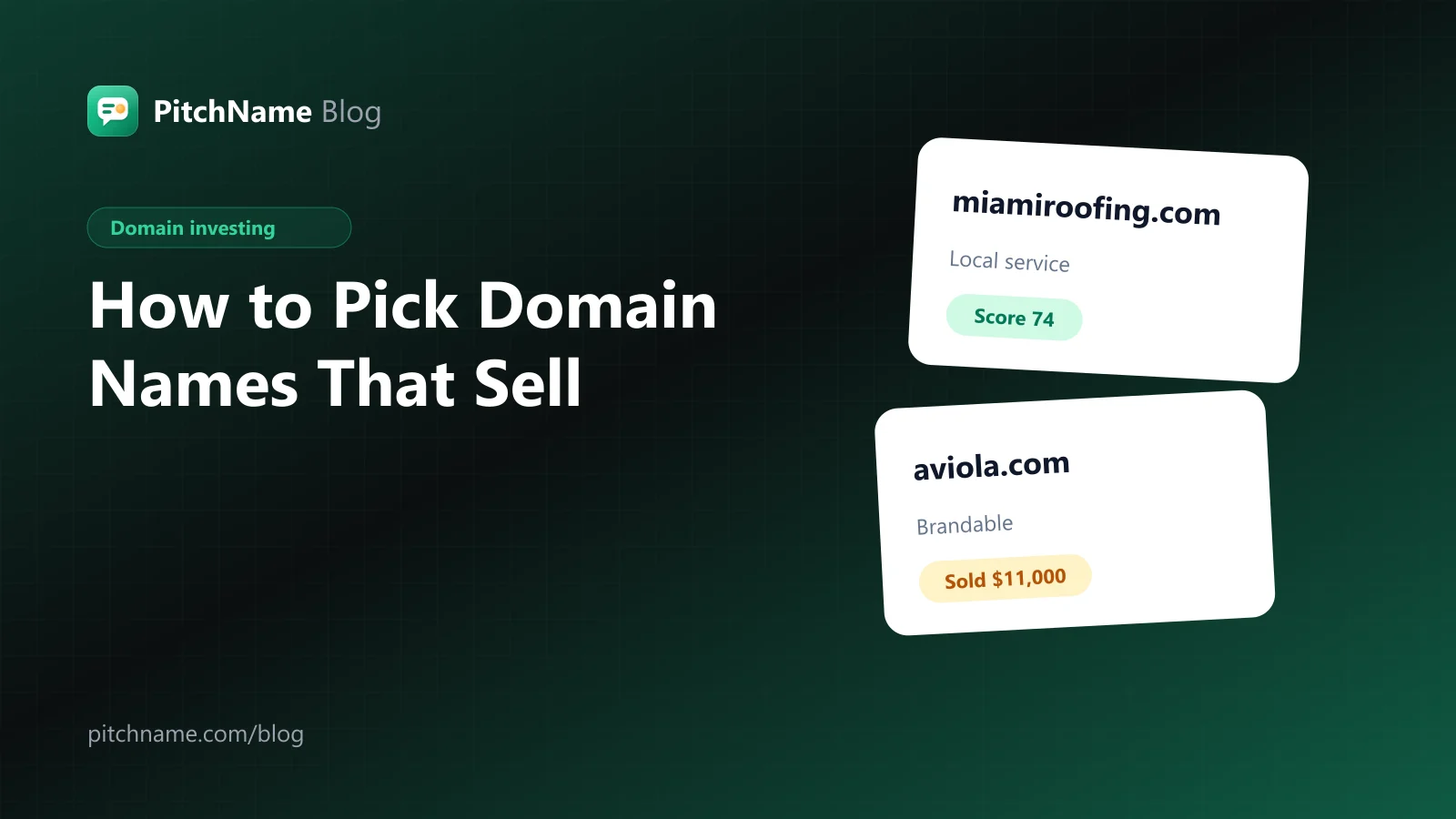
Names like miamiroofing.com or denverdentist.com. A local business sees the name as advertising that never expires: customers searching for that service in that city trust a name that says exactly what they want.
They work best when the service is valuable (roofing, plumbing, HVAC, dentists, lawyers, solar) and the city has many of those businesses, which means more possible buyers for one name. In big cities the plain names are long taken, but mid-size cities and strong variations (tulsaroofers.com, boiseroofrepair.com) are often still free.
2. Keyword names
Exact words for a product or service, without a place: roofrepair.com, buyhomeinsurance.com. Companies in that industry pay well for strong two-word commercial .com names. These are the hardest to find unregistered, so most are bought on the aftermarket.
3. Brandables
Short invented or compound words a startup can build a brand on. They have no dictionary meaning, and that is fine: most startup names are invented. Some recently reported sales from the domain aftermarket:
| Domain | Sold for |
|---|---|
| Aviola.com | $11,000 |
| Muali.com | $10,500 |
| NOVEOM.com | $7,000 |
| RotaStar.com | $6,000 |
What they have in common: short (5 to 8 letters), easy to say, easy to spell, and on .com. A name like qzxvbrnt.com is just as short, but nobody can pronounce it, so it is worth nothing.
4. Trending names
Names built on a term startups are chasing right now. In 2026 that means AI, agents, quantum, robotics and energy. AGINTS.com (it sounds like "agents") was reported sold for $12,522, and a one-word name like Trident.ai for $35,050. Trends move fast, though: names that ride a trend sell quickly while it lasts.
What makes a domain worth more
- .com first. Business owners trust .com and type it by default. Other extensions are worth much less, except a few tech ones like .ai and .io.
- Short and easy to say. If you have to spell it out on the phone, it loses value.
- Clear meaning or a clear buyer. You should be able to name the kind of business that would buy it.
- Real demand. If the same name is registered on many other extensions (.net, .io, .ai), people clearly want it.
- No trademarks. A name containing a brand can be taken from you and lead to legal claims.
Names to avoid
- Three or more words, and filler words: best, cheap, pro, online, now, 4u.
bestcheaproofingdeals4u.comis worth close to nothing. - Hyphens and numbers, unless the number is part of a real brand.
- Misspellings and typos, even of real words.
- Any brand or trademark, even a small one, in any language.
- Premium-priced new registrations. If the registry charges hundreds of dollars a year, the name must sell high just to break even. Our domain search flags premium names before you buy.
A 6-step checklist before you register
- Name the buyer. Can you list five real businesses that would want it? If not, skip it.
- Check the market. Search the business type and city on Google Maps. More strong businesses means more buyers.
- Check the price. Register at the normal yearly price, not a premium. Compare registrars in our price comparison; renewals matter more than the first year.
- Check for trademarks. Search the name and its words in a trademark database for your country.
- Get a second opinion. PitchName's AI Domain Rating scores a name and estimates its sale range, using real market signals such as how many other extensions are taken.
- Plan the sale. Before you buy, know how you will find the buyer. Our guide on how to find end-user buyers for your domains explains the signals that matter.
How many domains should a beginner buy?
Fewer than you think. Ten carefully chosen names you can actually sell beat a hundred random ones. Every name costs a renewal each year, so a large portfolio of weak names slowly drains money. Start small, learn what sells in your markets, and grow from there.
After you buy: selling is the real work
A domain does not sell by sitting in your account. Most end-user sales happen because the investor contacted the right business with a short, personal message. That is what PitchName is built for: it finds the businesses that match your domain on Google Maps, scores which ones are most likely to buy, and helps you write and track the pitches. See how to sell a domain to an end user and our domain outreach email templates to get started.
Frequently asked questions
How much can I make from domain investing?
It varies a lot. Most names never sell, and a few sell for thousands. Beginners who focus on names with a clear buyer and contact those buyers directly do much better than those who wait for offers.
Is .com the only extension worth buying?
For end-user sales, .com is by far the safest. Country extensions can work for local businesses in that country, and .ai and .io for tech names, but they usually sell for less.
Where do I find good available names?
Start with the domain name ideas tool: pick a market and a place, and it shows available names businesses would want. Then check each one with the checklist above.
Should I buy names on the aftermarket instead?
Once you know a market, yes: aged and keyword names on the aftermarket often sell better than new registrations. As a beginner, start with careful hand registrations to learn without risking much.
Picking domain names that sell comes down to one question: who will buy this, and why? Answer it before you register, and every name in your portfolio has a reason to be there.